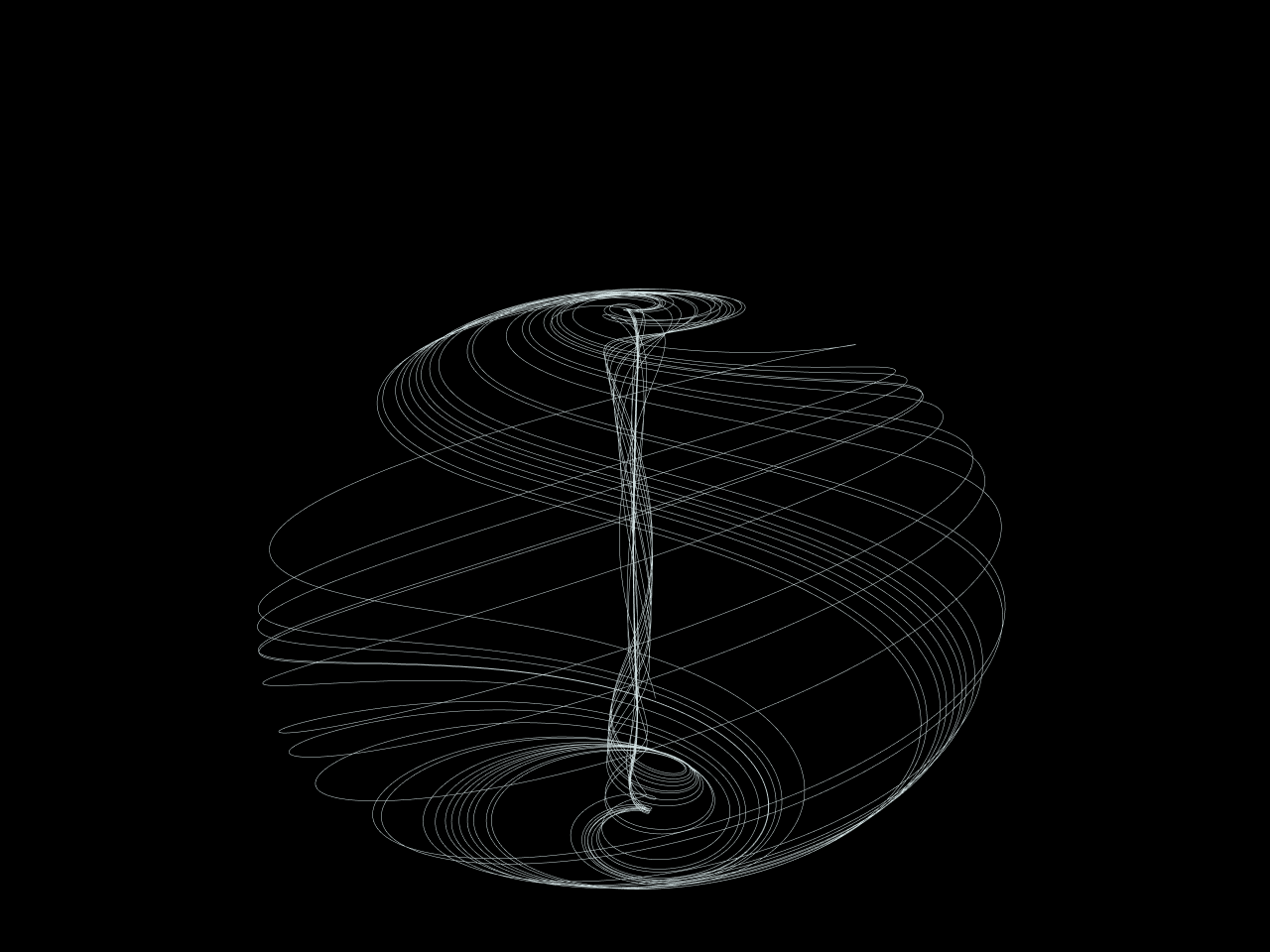
Aizawa’s round shell with a hole through it — Classical Chaos
Yoji Aizawa’s system is one of those 3D chaos demos that reads as a shape before it reads as equations: a round cloud with a clear tunnel through the axis. Lorenz gets the butterfly. Aizawa gets the punctured ball.
Classical Chaos draws it the same way as the Lorenz stage: Euler steps into a GPU line trail. The embed below only grows the trail in. Scrubbing length, drag-to-rotate, and the six coefficients live on the full canvas.
The ODEs
Six real parameters. On the Params panel they are knobs a through f, plus step size dt.
Defaults on Classical Chaos (close to the archive workshop: a=0.95, b=0.7, c=0.6, d=3.5, e=0.25, f=0.1, dt=0.01, seed (0.1, 0, 0). A second preset keeps the archive’s longer decimals.
Why it looks like a funnel
The \(x\) and \(y\) equations rotate and stretch in the horizontal plane as \(z\) changes. The \(z\) equation has a cubic restoring term and a radial factor \((x^2+y^2)\), so trajectories spend time on a thick shell and leave a quieter axis. That empty corridor is the “funnel” you see when the trail builds out.
Change d and the swirl tightens or loosens. Nudge a/c and the vertical thickness shifts. Nothing here is a mesh; it is only the orbit you integrate.
Trail, not a wrap buffer
The old workshop wrote points into a ring buffer and wrapped. Here n is trail length: grow, scrub, or hold, same contract as Lorenz. Change any of a…f or dt and the trail resets from the seed.
const next = aizawaTick(x, y, z, a, b, c, d, e, f, dt)
// store (x, z, y) scaled so the funnel stands upright