Barth’s sextic: where did those icosahedral spikes come from? — Classical Chaos
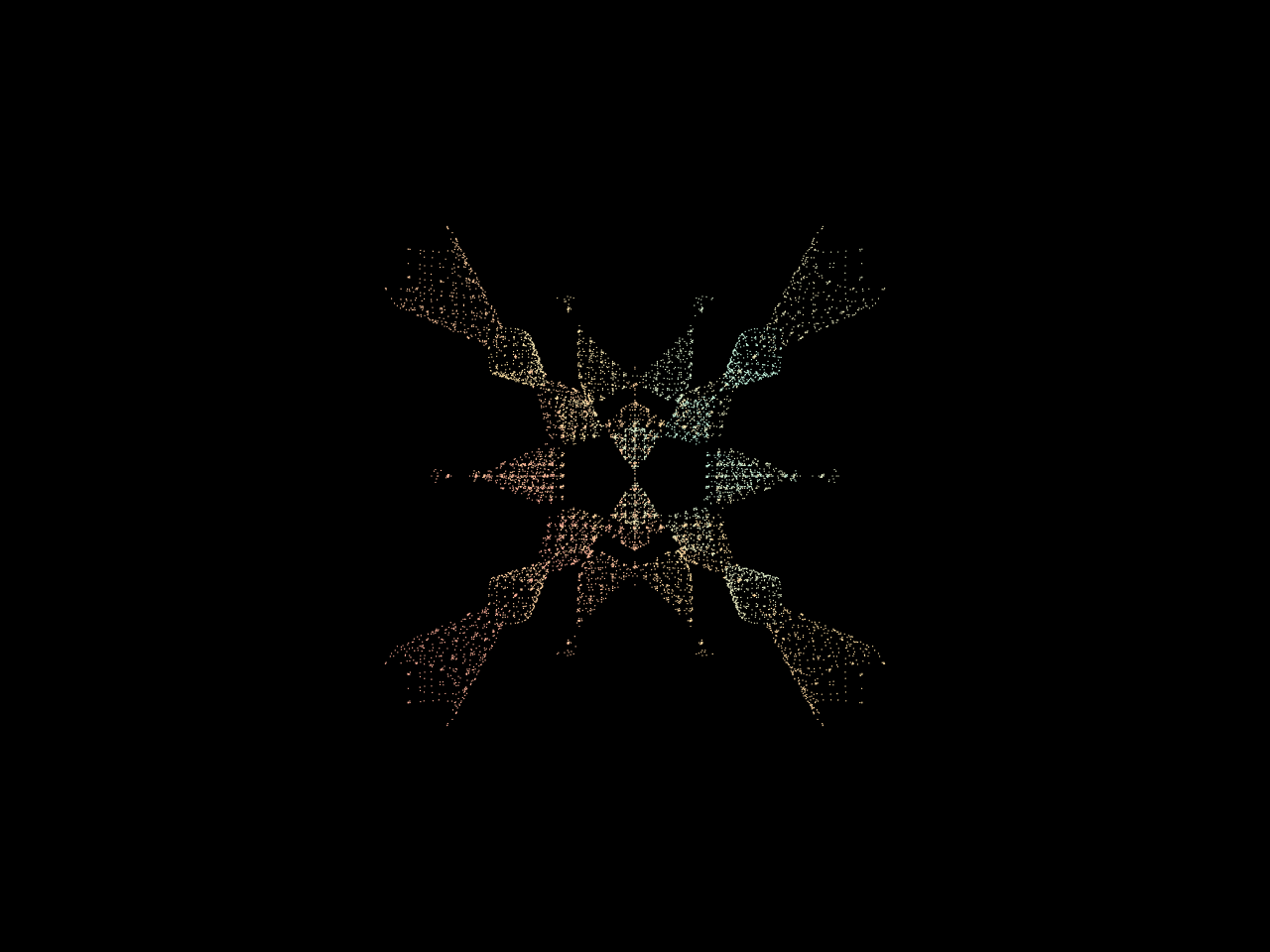
Barth’s sextic is a spiked shell with twelve-corner symmetry: a degree-6 equation in ordinary , written down by Wolf Barth in 1996. The shell is famous for nodes — pinch points where the surface crosses itself. The classic count is 65 in total, 50 of them real.
Classical Chaos draws a particle cloud on the isosurface, not a lit triangle mesh. Color runs coral → amber → teal by direction, and the cloud grows in on the card below.
The equation (where it hits zero)
The classic field sits at , the golden ratio, with sphere radius and mix weight . Write
The surface is where this formula hits zero:
That first product is the golden lattice. The second couples everything to a sphere of radius . True Barth keeps ; nudge τ and the spikes warp off the classic lattice.
How the points get there
Evaluate the field on a 3D grid, keep the vertices that sit on the zero isosurface, then light more of those points over time so the shell fills in:
for each grid sample (x, y, z):
  f = field(x, y, z; tau, radius, mix)
  if f crosses zero near this cell:
    keep a surface vertex
// draw more of those vertices as the cloud grows
The spikes are in the equation, not just the framing. On the full Barth stage, raising mix makes them bite; lowering it softens the shell.
Twisting the lattice
On that stage, tau stretches the golden lattice (φ is classic Barth), radius is the sphere term , and mix sharpens spikes or rounds the shell. Useful stacks: classic , lattice nudge , tighter/sharper .
Same family, very different how-spiky-vs-how-round feel.