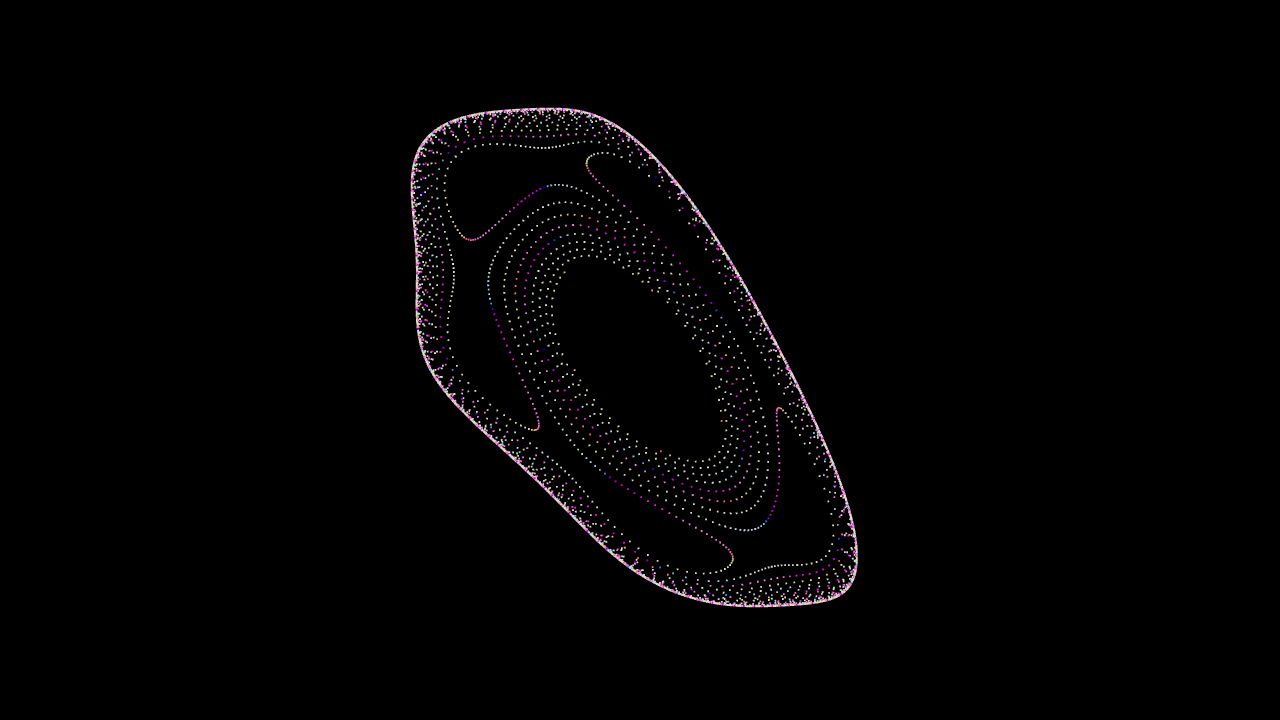
Bogdanov Map: a cloud that reshapes with a, b, and μ — Classical Chaos
The Bogdanov Map is a discrete 2D chaotic map (Rifkat Bogdanov). Start at a seed, apply a short rule, land on the next (x, y), and keep going. The picture is the pile of those landings — not a continuous trail of rates, not an ODE flow. Classical Chaos draws that pile live, colored along the sequence, newest tip yellow.
Defaults sit at seed (0.1, 0) with a = 0.0025, b = 1.44, and μ = −0.1.
Discrete map, not a flow
Each step is one jump from the last point. No integrating along a curve. Iterate from the seed and the landings fill a flat 2D cloud; hue walks the pile so older and newer spots stay readable. The yellow tip marks where the newest points sit.
Same seed, different a, b, or μ, and the silhouette reorganizes instead of just stretching a little.
What Classical Chaos iterates
Each step updates y first, then sets x from the new y:
const nextY = y + a * y + b * x * (x - 1) + mu * x * y
const nextX = x + nextY
x = nextX
y = nextY
a leans on the y term; b scales x(x − 1); μ couples the coordinates through x y.
Twisting a, b, and μ
On the full Bogdanov stage the knobs cover roughly a from 0 to 0.01, b from 0.5 to 2.5, and μ from −0.5 to 0.5, plus a scrub for how many points are lit. Change a knob and the cloud rebuilds from (0.1, 0).
Nudge b and folds thicken or thin. Push a across its tiny range and the whole field can rearrange without looking like a smooth morph. Twist μ and the coupling between axes shifts the pile.