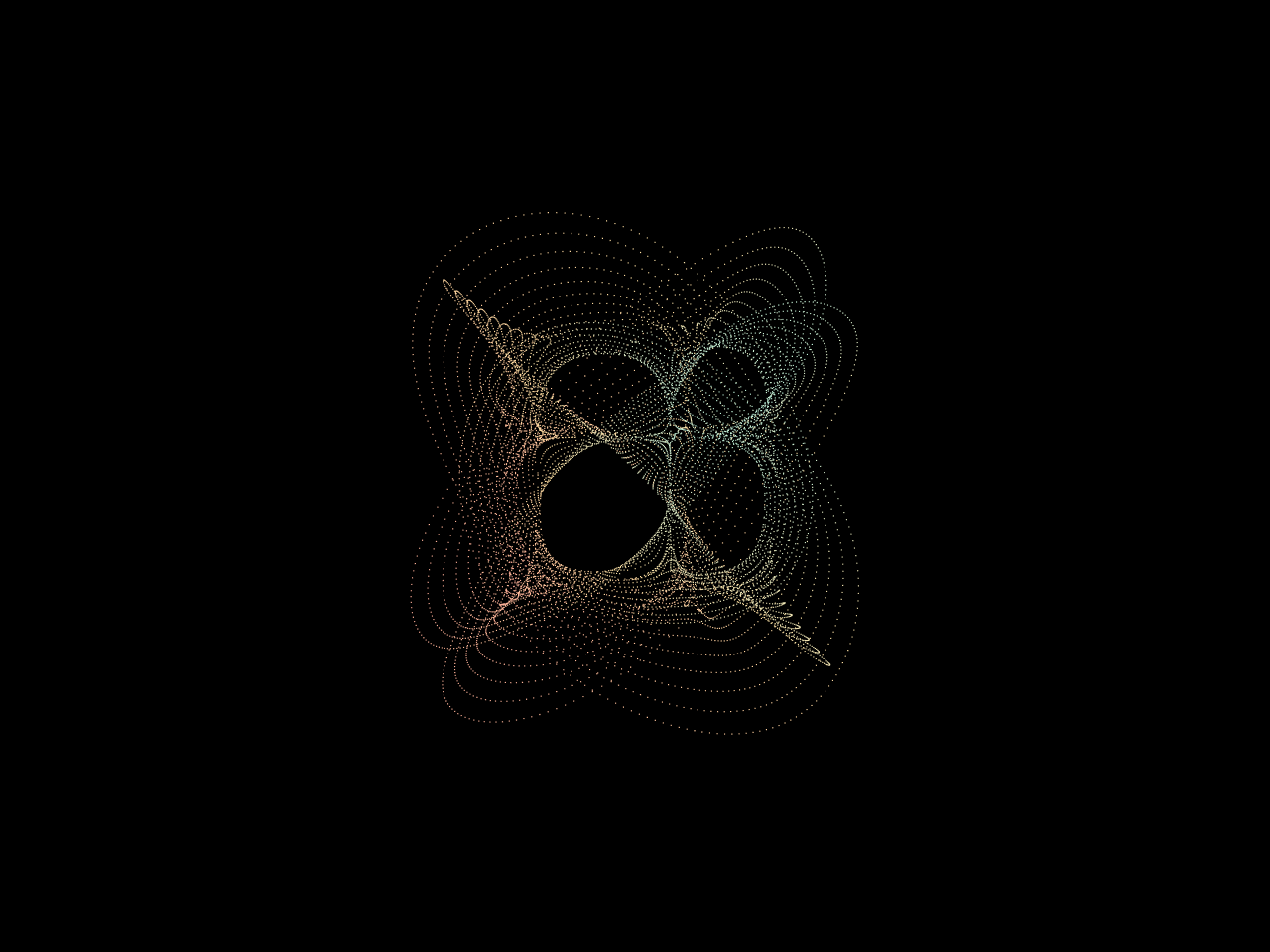
Calabi–Yau: a Fermat slice as a coral wire — Classical Chaos
A Calabi–Yau 3-fold is six-real-dimensional. Posters borrow the name for a familiar coral silhouette. What Classical Chaos draws is thinner than that name: a 3D projection of a 2-real-dimensional slice of a Fermat surface (Hanson 1994), rendered as a particle wire, not a lit mesh, and not the full manifold.
I first bumped into this picture — and how wild it is that people try to hint at higher-dimensional geometry on a flat screen — in The Final Verdict On The Theory Of Everything from History of the Universe. The video is excellent on its own; that is what pushed this coral wire onto Classical Chaos.
Fermat surface, then a cut
The Fermat equation in two complex variables is
in . Hanson fills a real 2D slice with branches that tile into the coral shape — indices over , :
Mixing angle folds the leftover imaginary parts into a third screen axis:
All branch patches get drawn. That patchwork is the coral wire that fills in.
What the wire looks like
It is a particle wire of the projected slice. Color runs coral → amber → teal by direction on the cloud. Points grow in over time until the cage is complete. Default degree is (the quintic poster case); mixing angle starts near .
Full canvas
On the full Calabi–Yau stage twist degree (2–8) and angle (0 to ), try the presets, and drag to rotate while the wire grows in.