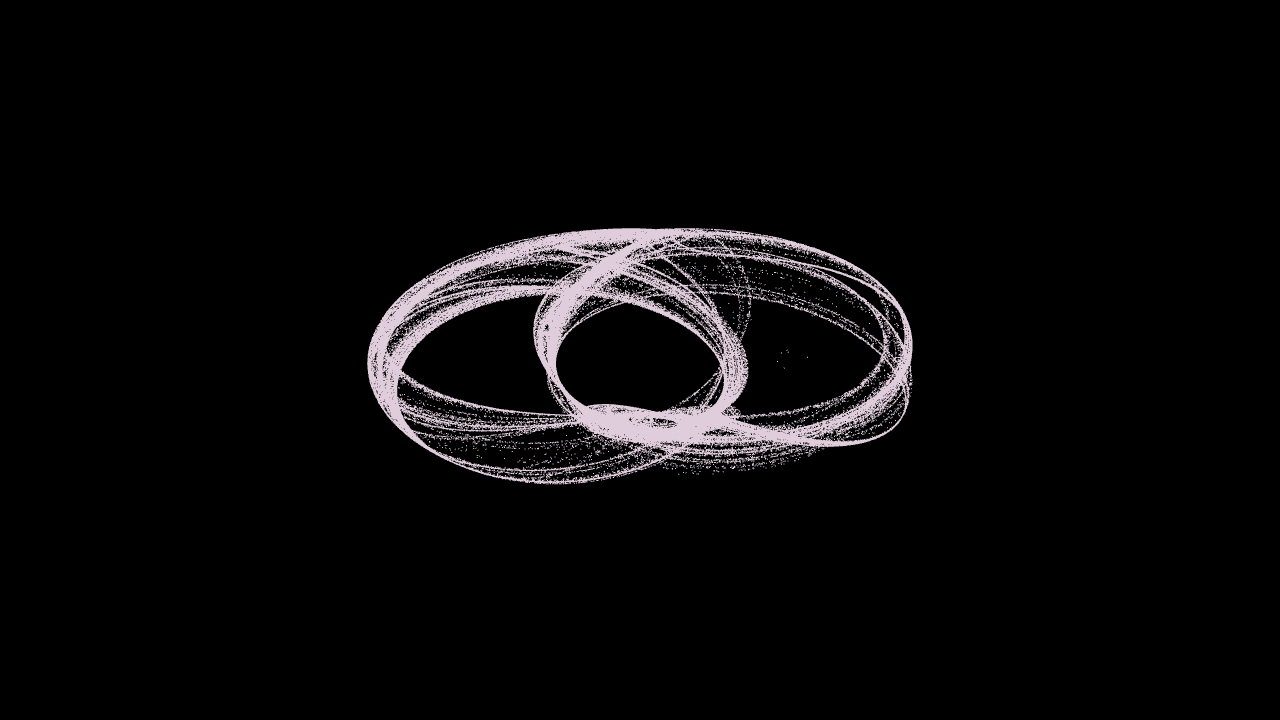
Clifford’s sine–cosine cloud — Classical Chaos
Clifford A. Pickover’s attractor is a tiny discrete map. You start at a seed, run a short sine–cosine rule, get the next (x, y), and pile those points until a cloud shows up. No continuous flow, no dt. Just iteration.
I keep opening it expecting something Lorenz-shaped. What I get is flatter and more ornamental: ribbons, loops, almost-cellular swirls depending on the knobs. The default on Classical Chaos is purple body, yellow tip, seed (−2, −2), knobs near a = 1.7, b = 1.8, c = 1.9, d = 0.4.
The map
Each step only looks at the last point and four constants:
x = Math.sin(a * y) + c * Math.cos(a * x)
y = Math.sin(b * x) + d * Math.cos(b * y)
Crossed arguments are the whole trick: a mixes into both the sine of y and the cosine of x; b does the same with the roles flipped. c and d scale the cosine pieces. Nudge one constant and the silhouette can jump from a soft loop into a tangled ribbon.
What I watch for
The tip stays bright so I can see where the map is “now” while the purple body holds the shape. Small moves on a / b / c / d (ranges about [−3, 3] on the full stage) rewrite the cloud from the seed. Generative-art people love this one for exactly that: tiny formula, huge shape space.
Full canvas
On the full Clifford stage you can twist those four knobs and watch the same seed rebuild.