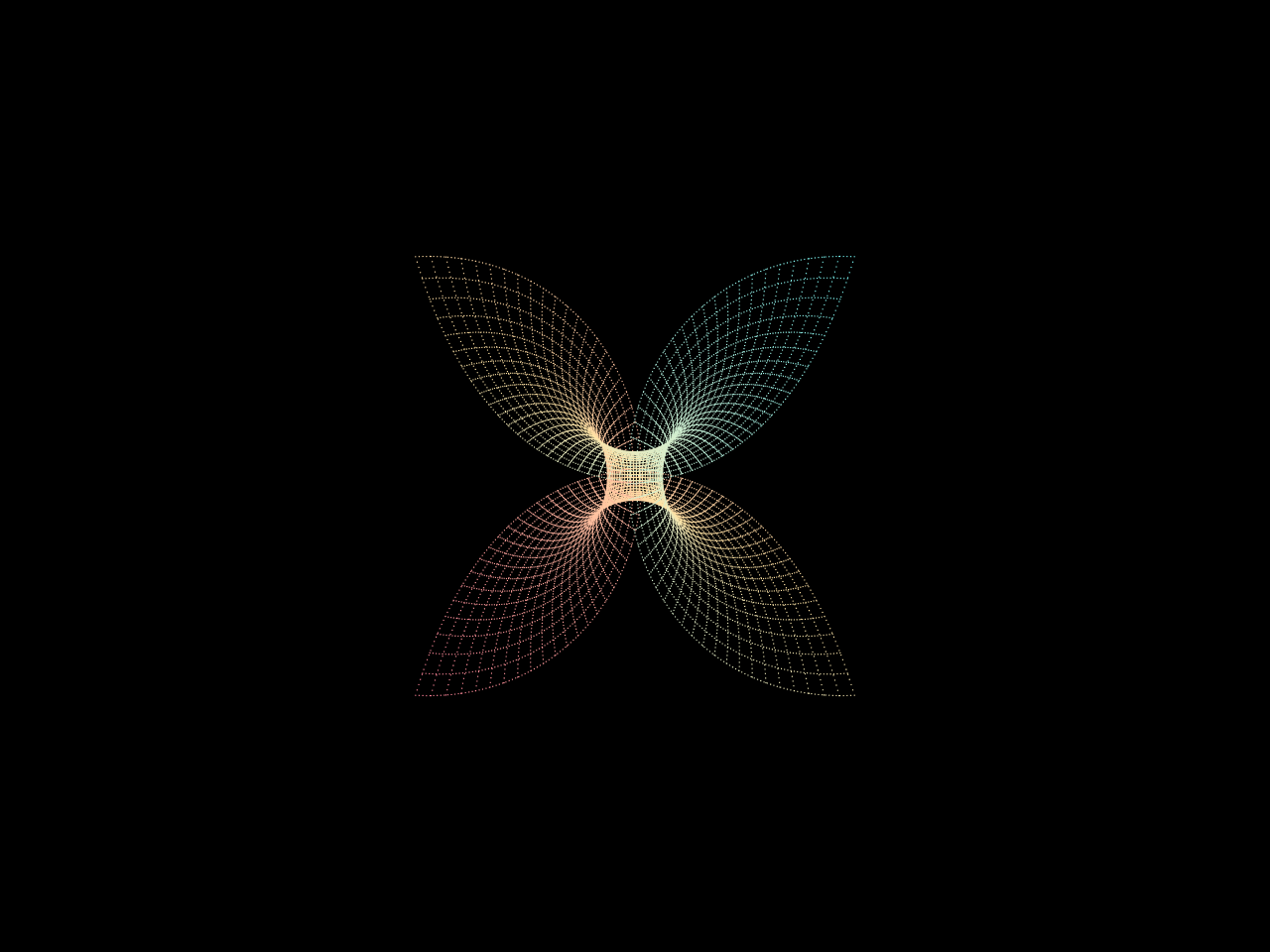
Enneper surface: a minimal sheet that crosses itself — Classical Chaos
Alfred Enneper’s surface (1864) is a complete immersed minimal surface: mean curvature zero everywhere, with a short polynomial map from the plane into 3-space. Classical Chaos draws it as a UV isoline particle wire, not a lit mesh, colored coral → amber → teal along the UV parameters.
Once the UV patch is large enough, the sheet crosses through itself. At the default span (1.8) those crossings already read.
A polynomial you can type by hand
Parameters u and v live in a square [−span, span]. The surface point is
No trig nest. Sample the formula on a grid and the classic Enneper surface is already sitting in three-space.
Minimal does not mean simple-looking. Mean curvature zero is a local bending condition. Globally the sheet is still allowed to dive through itself.
Isolines and span
The cage is UV isolines: curves of constant u crossed with curves of constant v. The grid crossings are how the wire reads.
On the full Enneper stage, higher span makes the self-intersections louder; toward 1.2 the cage calms. Presets jump to 1.6, 1.8, 2.0, and 2.4.
Growing the wire
A reveal count n lights more of the sampled points over time, so the cage grows in instead of arriving fully formed. On the full stage twist span, hit a preset, scrub n, and drag to rotate (or leave auto-rotate on).