Gumowski–Mira: a soft bump named G — Classical Chaos
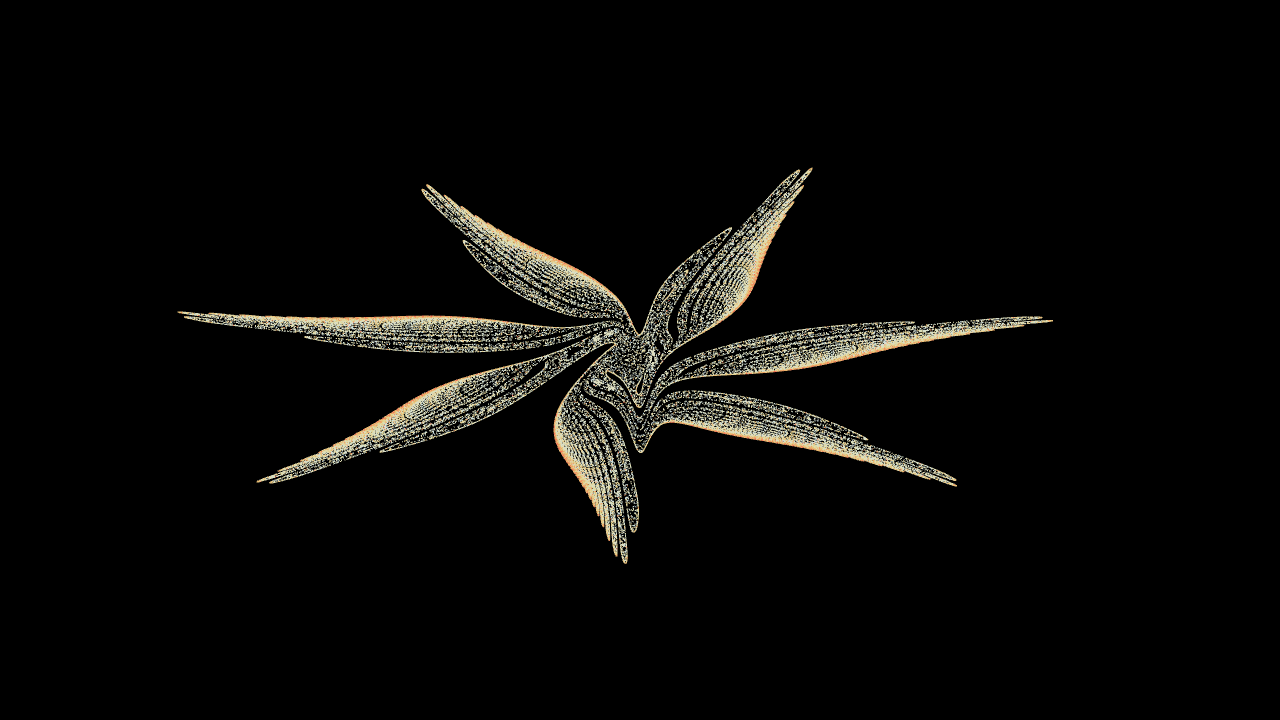
Gumowski–Mira is a discrete 2D map: take a point, run a short formula with a helper G, land on the next point, pile those samples into a folded silhouette. Named after I. Gumowski and C. Mira (accelerator / beam-dynamics lineage is the usual citation). Classical Chaos defaults sit near a = 0.008, b = 0.05, μ = −0.9, seed (0, 0.5).
The cloud below thickens as more iterates land.
The update rule
Each new point comes only from the last one. The canvas form Classical Chaos iterates:
That second G uses the brand-new x_{n+1}, not the old x_n.
Soft bump in G
G mixes a linear piece with a rational term. This is the form the canvas runs:
const G = (v: number) => mu * v + (2 * (1 - mu) * v * v) / (1 + v * v)
const nextX = y + a * (1 - b * y * y) * y + G(x)
const nextY = -x + G(nextX)
x = nextX
y = nextY
That fraction is a soft nonlinear bump. μ slides how linear vs bump-like G feels. Parameters a, b, and μ shape the outer silhouette; the seed only picks where the orbit starts. Stage ranges sit near a ∈ [−2, 1], b ∈ [−1, 1], μ ∈ [−2, 1].
Full canvas
On the full Gumowski–Mira stage twist a, b, μ, and the seed, or jump via the example presets. Same seed, different knobs, different folds.