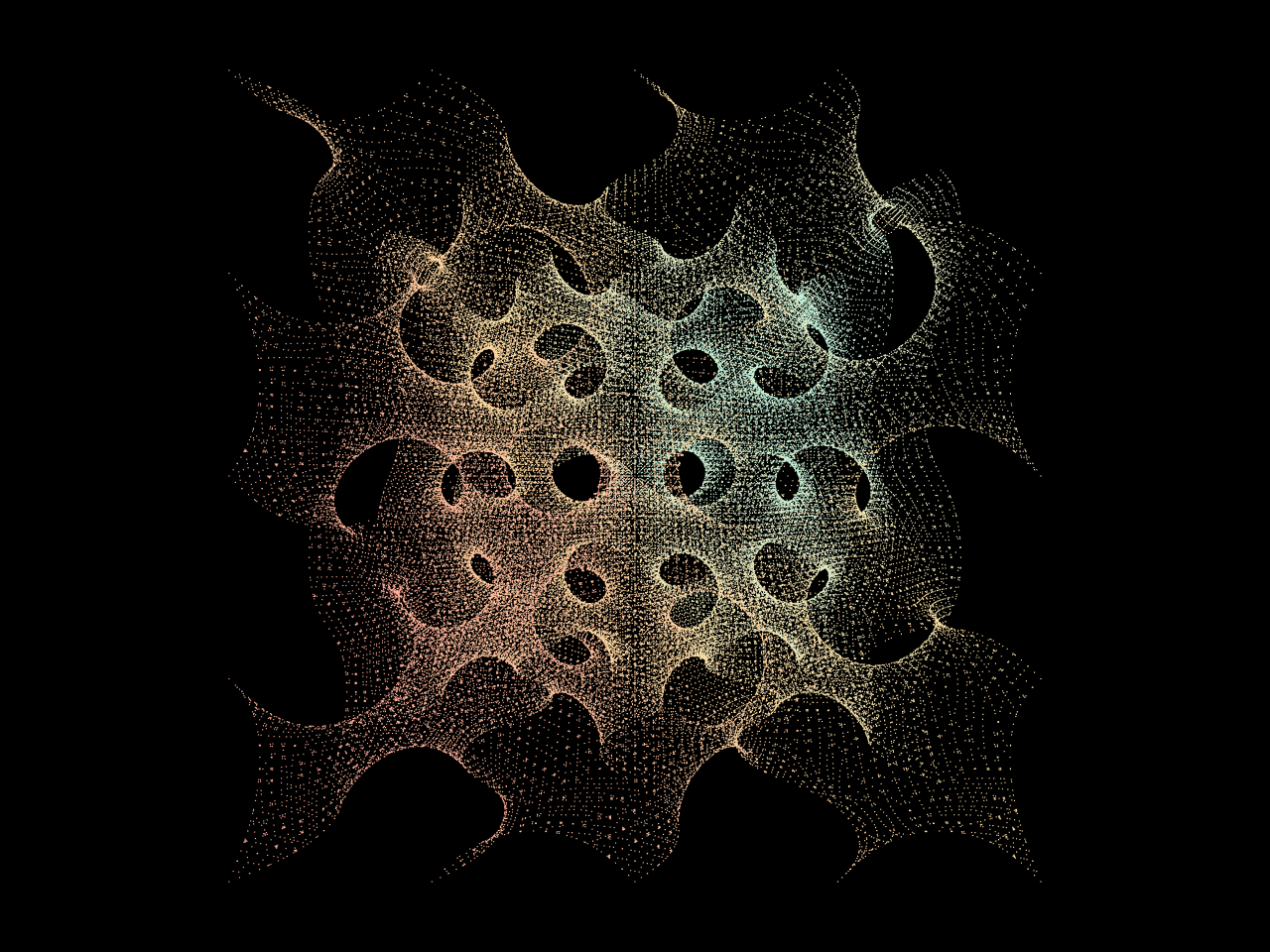
Schoen’s gyroid: a labyrinth that tiles space — Classical Chaos
Alan Schoen found the gyroid in 1970. It is a triply periodic minimal surface: a thin wall that divides space into two interlocking labyrinths and then repeats on a cubic lattice. Walk far enough in any lattice direction and the tunnels come back.
Classical Chaos draws that labyrinth as a particle wire — coral into amber into teal by direction — that fills in as more vertices appear.
Not the exact minimal surface
The true gyroid has mean curvature zero everywhere. Solving that as an exact mesh is a different project. Here the canvas uses a trigonometric approximation that sits close to the classic look without claiming to be the exact curvature solution.
The level set is
Sampling runs over a cube
and keeps the places where the left-hand side crosses t. Change t or tiles and the cloud rebuilds from scratch.
A single field eval looks like this:
const f =
  Math.sin(x) * Math.cos(y) +
  Math.sin(y) * Math.cos(z) +
  Math.sin(z) * Math.cos(x)
// keep vertices where f ≈ t
What t and tiles do
t is the iso-level. At t = 0 the balanced gyroid appears: both labyrinths share the volume evenly. Push t toward about ±1.2 and one side fattens while the other pinches. One number tips which maze owns the cube.
tiles is how many periods sit along each axis: an integer from 1 to 4. Default is 2 periods with t = 0. More tiles stack the tunnel motif denser inside the view; one tile shows a single clear cell.
On the full Gyroid stage, twist t and tiles, hit a preset (balanced default, a fattened t, denser tiles), scrub how much of the cloud is lit, and drag to spin while it auto-rotates.
Growing the cloud with n
n is how many of those isosurface points are showing. The embed grows n for you so the labyrinth assembles instead of arriving fully formed. On the full stage you scrub it yourself.