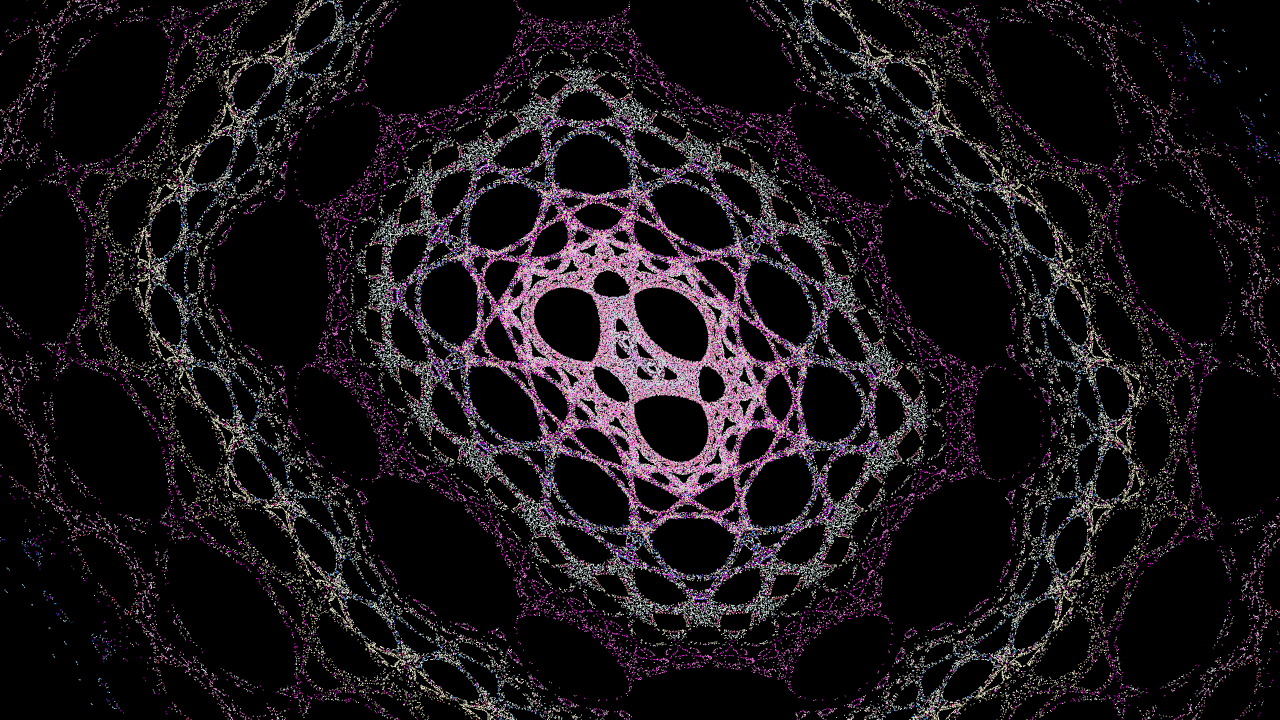
Four Hopalong variants, side by side — Classical Chaos
Barry Martin found the Hopalong map in 1981. People also call it the Skull attractor. Unlike Lorenz, there is no smooth trail of rates. You take a point (x, y), run a short formula, get the next point, and pile those points into a cloud.
I like it because the rule is tiny and the cloud still surprises me. Change one term and the whole field reorganizes. Below are the four versions Classical Chaos ships, all live at once so I stop relying on memory.
Four live clouds, side by side. Pause any card if you want quiet. Open full on a card when you want that variant’s knobs — this page is for looking, not tuning.
Map, not flow
Each new point comes only from the last one. No integrating along a curve. Start near a seed, keep iterating, and the silhouette that piles up is the attractor.
Classic Hopalong turns knobs labeled a, b, c. The other three use a, b, and μ (mu) on a shared outer shape. Either way: many steps from a seed, then a colored cloud.
Classic
Defaults on the classic stage sit near a = 1.4, b ≈ 5.16, c ≈ 2.74, seed (0.03, 0.01). Color walks through hue as the points accumulate so the cloud doesn’t go flat.
Some writeups use sign(x) and skip the extra −1 on the x-step. Classical Chaos draws this version:
const nextX = y - 1 - Math.sign(x - 1) * Math.sqrt(Math.abs(b * x - c))
const nextY = a - x - 1
x = nextX
y = nextY
On the full classic stage you can shove those knobs around (including a wild preset near a ≈ −11) and the cloud rebuilds from the seed. Open full on the Classic card when you want that.
Three cousins: only G changes
Positive, additive, and sinusoidal share one outer recipe and a seed near (0.723, −0.328). Think of a little helper G that twists the update. Same outer shape; different twist:
That second G uses the brand-new x', not the old x. The a(1 − b y²)y piece is feedback in y; with a = 0 it drops out and G does more of the work.
Positive keeps a signed square root — the flip that still feels related to classic:
Additive drops the sign: G(x) = √{|b x − μ|}. First time I flipped between those two cards I thought “same family,” then the missing sign erased a whole class of folds.
Sinusoidal swaps the radical for a sine:
Because sine stays between −1 and 1, that cloud feels calmer until the feedback term wakes up.
So classic stands alone with its two-line rule. The other three only disagree about G: signed sqrt, unsigned sqrt, or sine.
Looking at the cards
All four are point clouds from iterating a map. Tip points often read brighter. You are not scrubbing a trail or dragging a camera from these cards — just comparing shapes.
I keep coming back to the grid because serial comparison fails me here. I remember the last silhouette instead of the difference.