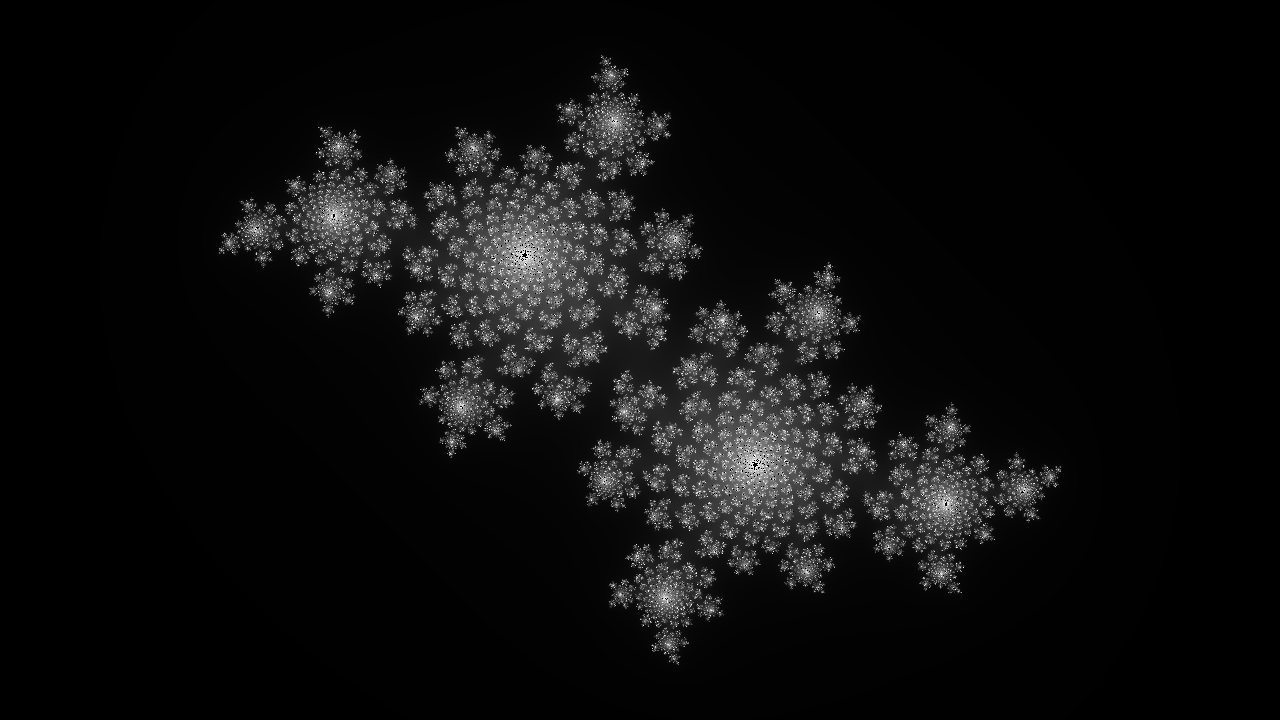
Julia sets: one fixed c, a whole plane of starting points — Classical Chaos
Gaston Julia studied these iterations around 1918. Fix one complex constant c, then ask which starting points z₀ stay bounded under the same quadratic map that draws Mandelbrot. Classical Chaos answers per pixel: the pixel is z₀, the greys mark escape speed, and black marks orbits that never clear the bailout inside the iteration budget.
Default c sits at (−0.4, 0.6): a connected black mass with greyscale lace outside.
Same map, swapped roles
The iteration is identical to Mandelbrot:
Mandelbrot always starts at z₀ = 0 and hunts which c keep the sequence bounded. Julia locks one c and paints the plane of starting z₀ instead, so every c owns a different picture. Connected blobs, dusty scrap, and filigree edges are all the same map with a different constant.
This is a shader, not a particle trail. The greys are already there: escape time per pixel, fading by how fast each orbit blew past the bailout.
One pixel, fixed c
The pixel is the starting z, not the constant. Add the same fixed c every step. Bail out when |z|² > 4 (that is |z| > 2).
let zRe = pixelRe
let zIm = pixelIm
let n = 0
while (n < maxIter) {
  const zr2 = zRe * zRe
  const zi2 = zIm * zIm
  if (zr2 + zi2 > 4) break
  const nextRe = zr2 - zi2 + cRe
  const nextIm = 2 * zRe * zIm + cIm
  zRe = nextRe
  zIm = nextIm
  n += 1
}
// n is escape time (or maxIter if still bounded)
Default max iterations is 256. On the full stage Params runs about 50–1000. Raise the budget when a zoom gets muddy near the edge.
What changes when you change c
Default framing sits near center (0, 0). Greyscale exterior, black set. On the full Julia stage, cReal / cImag each run about [-2, 2], and Params Examples jump classic values: (−0.4, 0.6), (−0.8, 0.156), (0.285, 0.01), (−0.70176, −0.3842). Pan and zoom dig into the lace; the HUD c barely moves while the edge densifies.
Arrive with ?cx= / ?cy= and the page seeds c from a Mandelbrot click.