Why the Lorenz attractor never closes — Classical Chaos
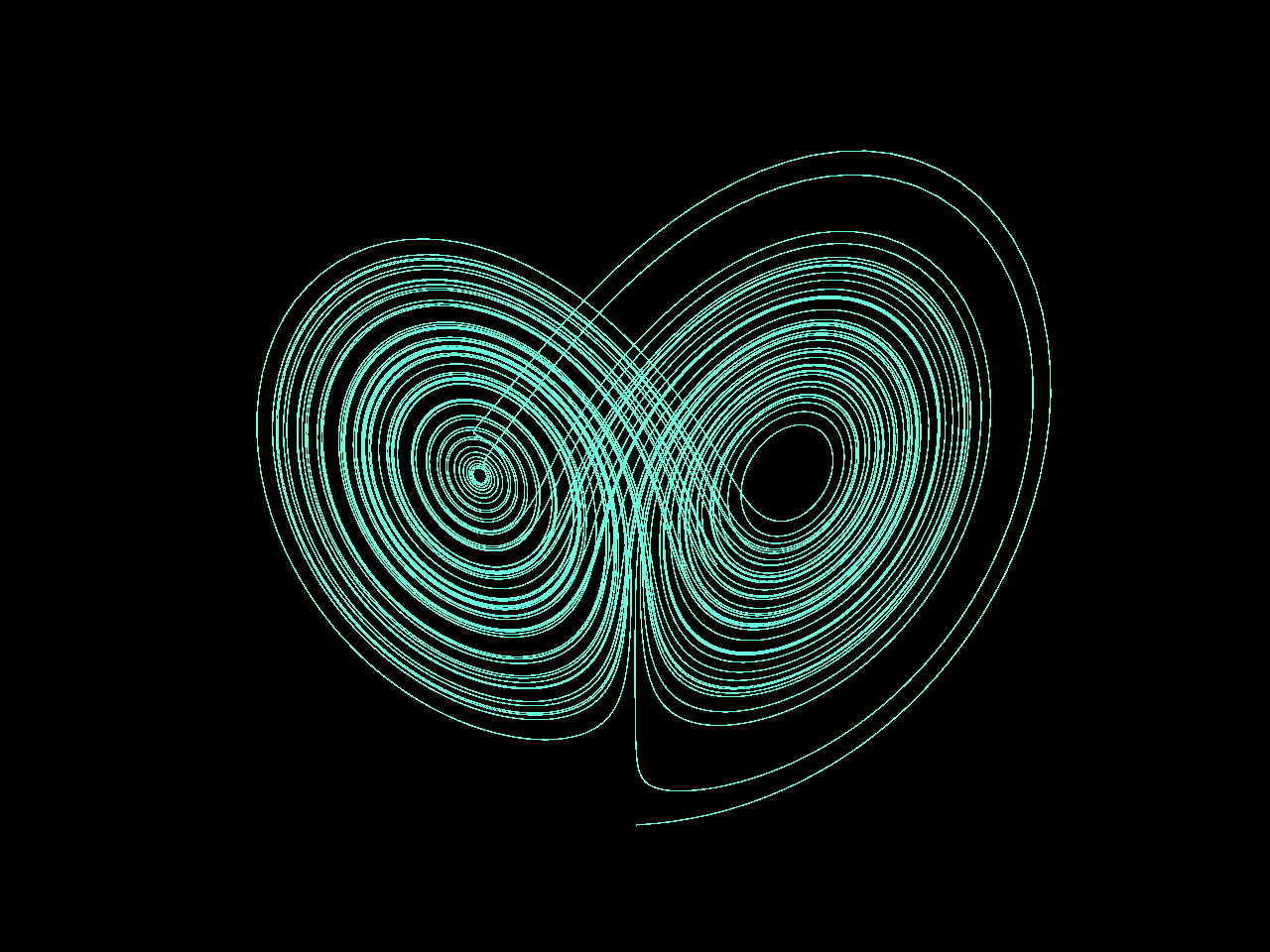
Edward Lorenz wrote down a tiny convection model in 1963 and ended up with a picture of deterministic chaos. Three numbers keep updating each other with no dice in sight, and the path still won’t settle into a neat loop. That shape is the first strange attractor most people meet: the butterfly.
On Classical Chaos the notebook embed below only grows the mint trail in. Scrubbing trail length, dragging to rotate the view, and retuning σ, ρ, or β live on the full stage (Goto full canvas at the end, or Open full on the embed).
Where it sits in the world
Lorenz was trying to understand atmospheric convection with a stripped-down ODE system. The surprise was not “random weather.” It was that a fully determined flow can stay bounded forever and still refuse a periodic orbit.
It stays in a box, never repeats on a timer, and a tiny seed change throws the path onto the other wing, which is why courses lead with this butterfly. I can’t keep the exact point, but the two lobes on the canvas still tell me what kind of motion I’m in.
The equations we integrate
On the full canvas, knobs a, b, c are the classical coefficients σ, ρ, β. Defaults: σ = 10, ρ = 28, β = 8/3, step dt = 0.005, seed (0.1, 0, 0).
We do not use a fancy integrator. One forward-Euler step runs once per sample along the trail:
const dx = sigma * (y - x)
const dy = x * (rho - z) - y
const dz = x * y - beta * z
x = x + dx * dt
y = y + dy * dt
z = z + dz * dt
Crude, yes. With this dt and ~15k samples it still draws the two lobes cleanly enough to read on a laptop.
What “never closes” means on a screen
A closed orbit would return to the exact same (x, y, z) after finite time. This trajectory comes near old states and peels off again. That is a property of the continuous flow.
On a computer the story is messier. Finite floats and a fixed step will eventually cycle if you wait long enough. So the claim in the title is about the math object, not about promising an infinite non-repeating float stream. We still draw a finite trail. Here the embed lengthens it for you; on the full stage you scrub that length with n.
How we store the path
n is just “how much of the saved trail is lit.” The ODEs are continuous. What we store is a discrete orbit
with r = (x, y, z) and ṙ the Lorenz vector field above. Growing n means more Euler steps from the last saved state; shrinking n means drawing a shorter prefix of the same buffer (no re-integration). Change σ, ρ, β, or dt and the discrete orbit is invalid, so we reset to the seed and integrate again.
if (paramsChanged) {
  x = 0.1
  y = 0
  z = 0
  computed = 0
}

while (computed < n) {
  const dx = sigma * (y - x)
  const dy = x * (rho - z) - y
  const dz = x * y - beta * z
  x += dx * dt
  y += dy * dt
  z += dz * dt
  // store r_k, then…
  computed += 1
}
Why the plot is not raw (x, y, z)
Phase space is not camera space. We remap so the lobes sit left and right, with height along z:
X and Z are a 45° turn in the xy-plane (the usual Lorenz front view). Subtracting ρ − 1 from height recenters the cloud where the classic parameters live. The 0.22 on Z squashes depth so perspective does not turn the line into a thick scribble.
Color is only a fade along the sample index (mint body, brighter tip). Notebook embeds grow n up from zero so you see the discrete orbit lengthen instead of appearing fully formed.
Twisting the knobs
On the full stage, change ρ and the lobes fatten or die. Nudge dt and the trail gets silky or jagged. None of that needs a random number generator. Coupled rates, a fixed step, then that small remap: nothing else is hiding under the hood.