Roman surface: Steiner’s self-crossing RP² — Classical Chaos
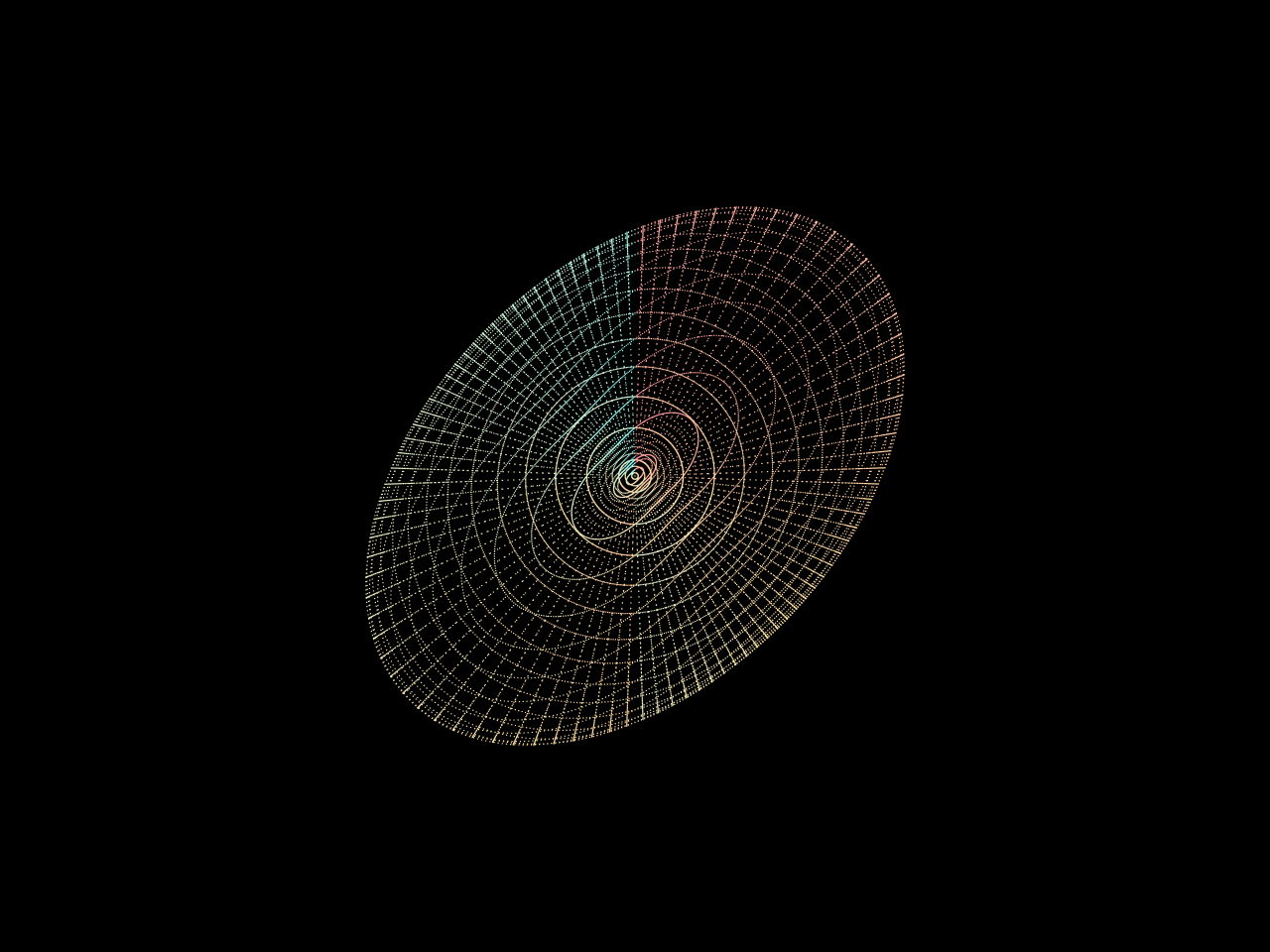
Four soft lobes meet in the middle, like a tetrahedron that forgot to stay sealed. Then the lobes slide through each other. That crossing is the story. Steiner called this the Roman surface (mid-1800s, after work he presented in Rome). RP² means the real projective plane: one way that plane shows up in ordinary 3-space is an immersion where the lobes have to cut through each other.
Classical Chaos draws it as a UV isoline particle wire, coral → amber → teal along the parameters, growing in over time.
Four lobes, and they cross
Default proportions look Steiner-ish. Treat the silhouette like a sealed balloon and the picture fights you; accept the crossings and the immersion of RP² in R³ starts to read as the shape that fits on a screen.
Boy’s surface does the same topology with a different silhouette.
The (u, v) map
With parameters and a scale , Steiner’s map is
const x = a * a * Math.cos(u) * Math.sin(u) * Math.sin(v)
const y = a * a * Math.cos(u) * Math.sin(u) * Math.cos(v)
const z = a * a * Math.cos(u) ** 2 * Math.cos(v) * Math.sin(v)
On Classical Chaos a is fixed at 1, then a separate squash stretches z before the cloud is rescaled to fit the view. Warm hue near one end of the UV walk, cooler toward the other, and the grid stops reading as a random spray.
Wire and squash
The cage is constant- and constant- curves sampled as points — isolines, not a shaded shell. How much of the wire is lit is reveal count n; the embed grows that in.
Knob squash stretches . Default is 1 (Steiner proportions); the range runs about [0.25, 2.5]. Push it flat or tall and the four-lobe silhouette changes character without changing the formulas above. Full-stage presets sit near 0.45, 1, 1.6, and 2.2.
On the full Roman stage twist squash, hit a preset, scrub n, and drag to rotate (or leave auto-rotate on).