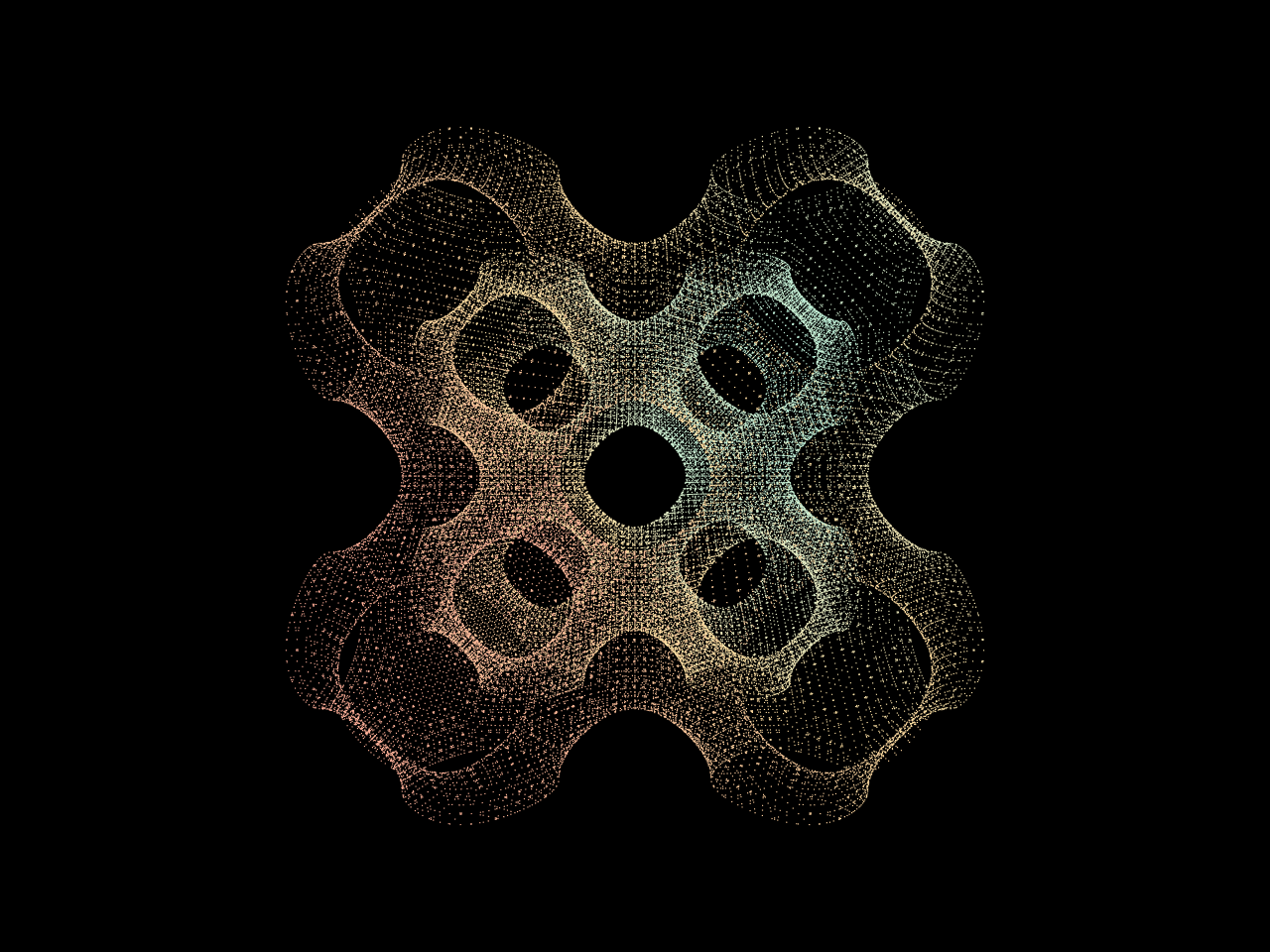
Schwarz P: a labyrinth that tiles the cube — Classical Chaos
Schwarz’s primitive surface (usually just “P”) is a triply periodic minimal surface: a two-sided labyrinth on a cubic lattice. Same family energy as the gyroid, but the lattice reads squarer — more brick-cell than swirl.
Classical Chaos samples a trigonometric approximation and grows a particle wire, coral → amber → teal by direction, so the tunnels fill in before thickness and tiling get twisted on the full stage.
The trig field behind Schwarz P
The field is a sum of cosines on a cube of side length :
t is the iso-level (thickness on the stage). Default t = 0 is the balanced, classic P look; the knob runs about [-1.2, 1.2]. The field is -periodic in each axis. At t = 0 it vanishes at — a handy check that the trig field matches.
This is a trig approx for the classic look, not an exact minimal mesh.
Growing the wire
n is how many of the sampled points are lit. Points come from sampling the isosurface, then showing a cloud. The embed grows n so the wire appears instead of arriving fully formed. Color runs coral → amber → teal by direction and reads on black once the view starts turning.
Morphing thickness and stacking cells
Changing t morphs labyrinth thickness and openings: tunnels fatten or pinch. Changing tiles stacks more periods in the frame (integer 1…4; default 2).
On the full Schwarz P stage scrub n, twist t and tiles, and try presets (start at t = 0, tiles = 2, then nudge t toward 0.45 or −0.35, or bump tiles to 3 or 4). Drag to rotate while auto-rotate stays on.